You don't have a discipline problem. You have a self-trust problem.
Every abandoned plan makes the next one harder to believe. Cicerone helps you rebuild that trust with one small promise today, then saves the win as proof.
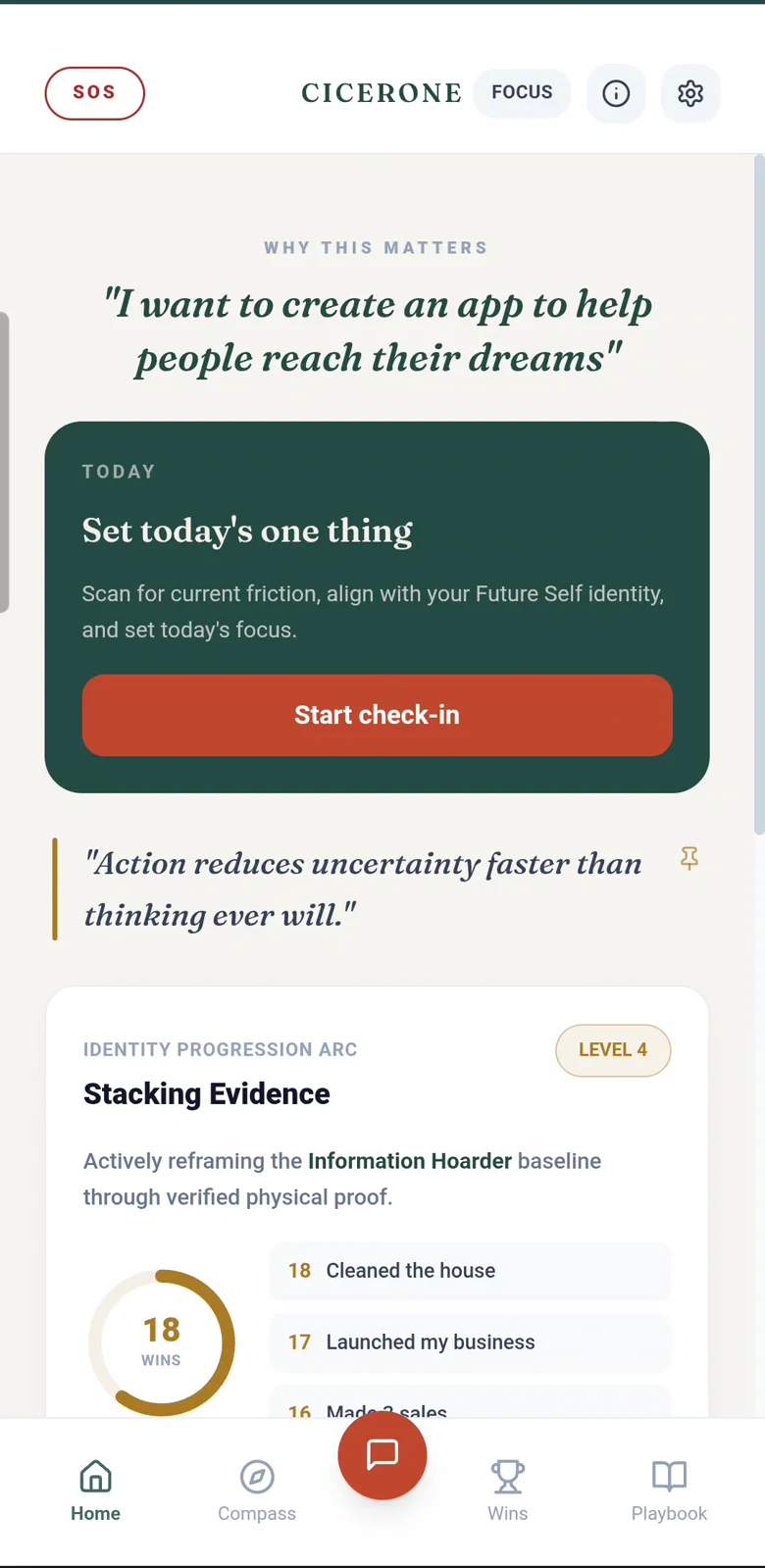
Your brain trusts records, not speeches.
You have tried talking yourself into confidence. It never holds, because your brain has your history, and history wins the argument.
So Cicerone doesn't ask you to believe anything. It asks you for one small action a day, then writes it down, dated, in your own words. On the days you feel like a fraud, you don't argue with the feeling. You read the receipts.
Self-trust is not a feeling. It is a stack of receipts.
Psychologists call the mechanism self-perception: we infer who we are from watching what we do (Bem, 1972).
One small promise a day. Kept, then written down.
Five minutes is not the compromise. It is the mechanism: small enough to happen on the bad days, real enough to count as proof.
This is for the other ones.
Every productivity app works fine when you're fine. Cicerone is also built for 11pm when you're stuck, spiraling, or about to quit on yourself again.
A coach that learns what gets you moving.
Trackers record what you did. The Thought Partner talks back: it holds the goal you set, spots the pattern behind the missed days, and turns “I'm stuck” into one small move.
“This app is a wonderful tool for personal growth. It's helping me believe in myself again by focusing on one small promise at a time instead of chasing perfection. The Evidence Archive reminds me how far I've come, and the Thought Partner keeps me moving forward with practical, encouraging guidance. A simple but powerful app that's helping me grow as a person and trust myself again.”
From a review on Google Play
Start with 7 days free.
Pick a plan. The app has a week to earn its place.
Stripe shows the same numbers at checkout. Nothing is charged until your 7 free days end, and cancelling before that takes a few clicks.
Prefer it on your phone?
One subscription works everywhere you use Cicerone.

I built Cicerone because I was the person with every answer and none of the follow-through. This is the system I needed. Run the first week free and see what it does to your days.
Damiano, founder of The Cicerone Method
You already know the advice. That was never the problem.
Ask any AI and you get a tidy list you have read before. Cicerone does the other half: one small promise today, and the proof that you kept it. Pick whichever one sounds like your week.
Every other AI
Cicerone
Example answers. Yours are about your actual week, in your own words.
The questions you're probably asking.
I have ADHD and systems never stick. Is this different?
The ADHD space is full of feature lists that do not survive week two, because features are just more executive function to spend. Cicerone works underneath that. It is identity-based: instead of chasing goals, you stack proof of who you are becoming, the self-perception mechanism psychologists have described since Bem (1972): we infer who we are from watching what we do. It is low friction: five minutes counts, and starting never depends on how you feel. And it is built for the moment ADHD systems die, the day you vanish: it meets you without shame, the coach talks you back in, and a missed day is treated as data, not a broken streak. Nothing in it asks you to try harder; it asks you to decide less.
Isn't this just another productivity system I'll abandon in a week?
Every system you've abandoned assumed you'd never miss a day, and punished you when you did. Cicerone assumes the opposite: it is built around the day you fall off. There's a recovery protocol for that exact moment, your coach notices and pulls you back, and a missed Tuesday never becomes a lost month. The no-shame part is not softness, it is what the evidence supports: students who forgave themselves for procrastinating procrastinated less the next time (Wohl, Pychyl and Bennett, 2010).
What happens when I miss a few days?
Expected, planned for, and recoverable. The Momentum Recovery protocol gets you back in minutes without "starting over," and your evidence archive doesn't get deleted because you had a bad week. The research is on your side here: in the classic habit-formation study, missing a single day made no measurable difference to whether the habit eventually formed (Lally and colleagues, 2010). The miss was never the problem. Not coming back was.
Why not just use Notion or a habit tracker?
Trackers record what you did. They don't tell you what to do next, notice your patterns, or say anything when you drift. Cicerone prescribes: one focus for today, the right protocol for the block you're hitting, and a coach that talks back. It's the difference between a spreadsheet and a corner man.
How much time does this actually take?
Five minutes a day is the designed minimum, one focused move plus logging one win. The system is deliberately small, because the entire point is a practice that survives your worst weeks, not your best ones.
Does Cicerone work on my phone?
Yes, on iPhone and Android both. Add it to your home screen and it opens full screen with its own icon, exactly like any other app. There is nothing to download and nothing to wait for, and it works the same on your computer.
Can I get this on the App Store or Google Play?
Cicerone is on Google Play now, and the iOS app is on its way to the App Store. You do not need either one, because the version on your home screen is the full app. Your subscription works everywhere, so there is never a reason to pay twice or install both.
If I install the Google Play version, does my progress carry over?
Not on its own, so it is worth picking one and staying there. Cicerone from our site keeps your entries in your account, so they are waiting on any device you sign in on. The store apps keep entries on the device itself. Your subscription follows you either way. If you wish for your progress to transfer across, reach out to our team at support@theciceronemethod.com.
What if it's not for me?
Then it costs you nothing. Every plan starts with a 7-day free trial: $0 today, run a real week, meet your Thought Partner, and cancel in a few clicks before the trial ends if it is not for you.